FAILURE TO HAVE A BLOOD AND URINE REFERENCE
RANGE STANDARD
When we have a blood or urine test done, in a laboratory in Florida,
they indicate if the value of a certain component of the blood or
urine is too high or too low based on what they believe is the normal
range for that component.
However, I have noticed that there is no real standard that they all
abide by. And all seem to have different values for what they
consider normal ranges.
And they don't say if that "normal range" is for everyone. Is
it applicable to all men and women? Did they use statistical data of
healthy individuals to determine the normal values? Where all the
individuals adults? How many were young? How many were old?
Who knows?
Someone in the National Institute of Health, or the National
Academy of Medical Science, or some government agency, should
set a national standard that all laboratories should abide by.
However, I am not a doctor, medical scientist, politician, nor a
billionaire that gives large contribution to political parties. I am
just a smart dude who notices things that other people overlook or
ignore. Therefore this advice will probably be ignored.
Am I wasting my time doing this? Or may be I am too hopeful that
someone, with the ability to do something about this, will
accidentally (or by destiny) happens to enter this web page, reads
this and resides that he or she can do something about it.
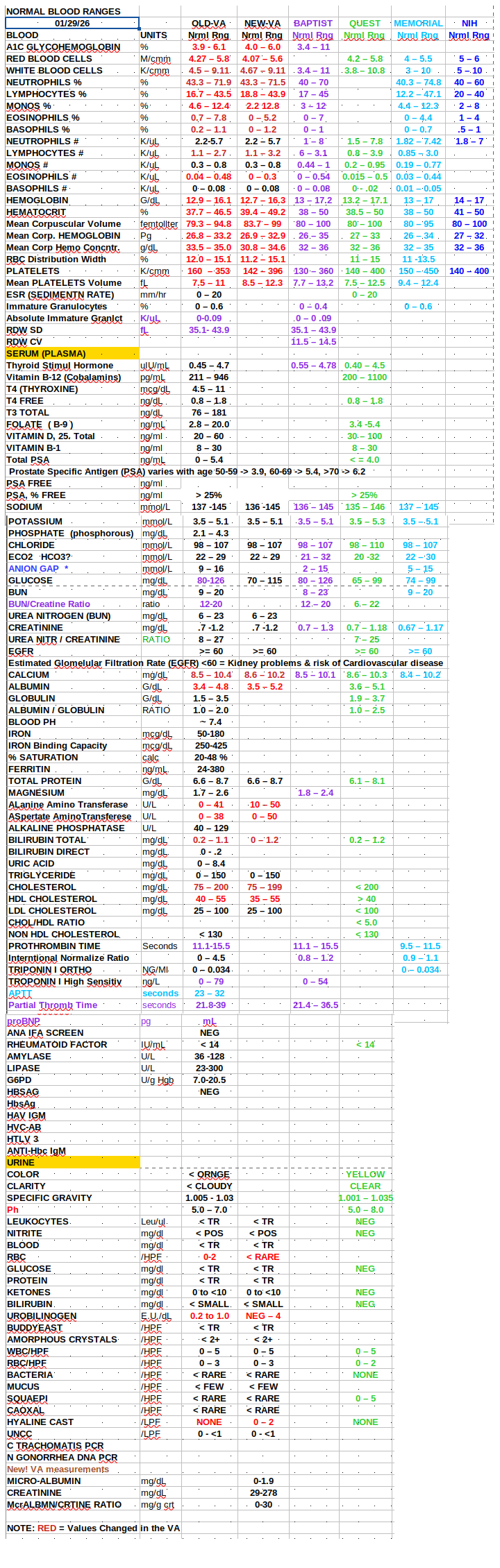
Here is a brief and simple example, although not complete, in a
spread sheet format, of some of the values that Memorial Hospital,
Baptist Hospital, Quest Labs, NIH, and the VA (Veterans
Administration Health Care System) consider normal ranges. I
also noticed that during the last 15 years, the VA has made some
changes to their normal ranges. The values that were changed
are in red.
RETURN